Understanding Financial Toxicity

Reading Time: 6 minutes
Cancer costs more than treatment. Hidden expenses like gas to get to treatment or meals near the hospital add up to financial toxicity.
When people think about the cost of cancer, they often think of hospital bills. But for many families, that is only part of the story. There is gas money for trips to treatment. There is the paycheck that stops when a parent can’t work. And the rent is still due on the first of the month.
There is a name for this: financial toxicity. It means both the stress about money and real material changes in quality of life caused by added costs that come with cancer. Like other side effects of treatment, it can affect how people feel and the care they get.
Today, we’re breaking down what financial toxicity is, why it matters, and what Family Reach is learning from our own research. We recently shared some of that research at the ASCO Quality Care Symposium in Boston on October 16, 2026.
What Is Financial Toxicity?
Doctors use the word toxicity to talk about harmful side effects of treatment, like nausea or feeling very tired. Cancer doctors and researchers now use the term financial toxicity to make a point: stress and problems around money are a side effect, too (Edward et al., 2023).
Financial toxicity can show up in three ways:
- Bills and debt: the direct financial strain of cancer, such as falling behind on bills, borrowing money, or using up savings.
- Worry: the emotional stress of not knowing how to pay for treatment and everyday expenses.
- Hard choices: decisions people may feel forced to make when costs get in the way, such as putting off care or skipping medicine.
Financial toxicity is common for many people with cancer, though how often it happens can vary by health care system, insurance coverage, treatment type, and personal financial situation.
The Unplanned Costs of Cancer
Insurance is meant to help pay medical bills, but many of the biggest financial pressures that come with cancer are not medical at all. Families may have to manage:
- Gas, parking, and rides to treatment
- Meals and hotel stays near the hospital
- Lost income when a patient or caregiver can’t work
- Everyday bills like rent, groceries, and utilities
Insurance usually does not cover these burdens. And caregivers often feel the strain, too, when they miss work to care for a loved one.
Having insurance does not make a family immune to financial strain. In a 2024 survey, almost half of people with cancer said they had medical debt from their care. Nearly all of them had insurance (ACS CAN, 2024).
We see this need every day at Family Reach. In 2025, we provided nearly 147,000 services to 51,000 patients to help them manage the financial pressures of cancer. Each family had their own unique situation and needs, but overall, the support we provided centered on a few basic needs:
- 59% faced food insecurity
- 55% couldn’t afford to get to treatment
- 54% were behind on utility bills
- 44% struggled to pay for housing
The needs are substantial, but what these numbers don’t tell on their own is that most families needed help in more than one area. About two-thirds needed support with two or more of these basic needs at the same time. Together, these overlapping needs show why financial support must be flexible and responsive: so families can stay focused on treatment instead of choosing which essential bill to pay.
Why It Matters for Health
Financial stress is about more than the money — it can change the care people get.
When bills pile up, people can face impossible choices that affect their health. Among people with cancer-related medical debt, 1 in 4 said they had skipped or delayed care to avoid more debt, and more than 1 in 4 had gone without enough food (ACS CAN, 2024).
When several needs pile up at once, something has to give. A family that is behind on rent and low on gas may have to choose between keeping the lights on and getting to treatment. Picking up medicine can slip down the list. Over time, choices like these can make it harder to get well.
What Our Research Shows
Numbers can show how common financial stress is, but they can’t show what it feels like — so we asked.
In late 2025, we held six small group conversations, called focus groups, with 37 adults with cancer who had received financial help from Family Reach. Four groups were in English and two were in Spanish. We recently presented what we learned at the ASCO Quality Care Symposium on October 16.
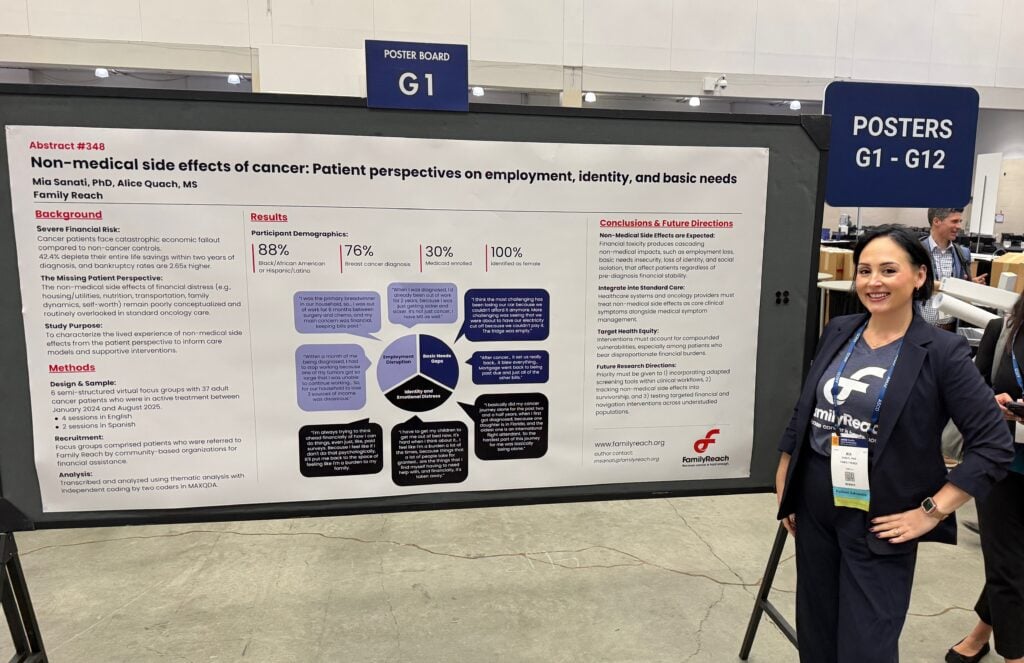
Many focus group participants told us that the money problems that brought them to Family Reach often started with changes in their work situations during cancer treatment. Then they spread. Here is what we heard:
- Work changes. Many people had to cut their hours, take leave, or stop working. Many were the main earners in their homes. As one person said, “Within a month of me being diagnosed, I had to stop working.”
- Trouble paying for basics. People made hard choices between food, bills, rides, and rent to keep treatment first. “We were about to have our electricity cut off because we couldn’t pay it. The fridge was empty.”
- Feeling like a burden. Not being able to provide for their families hurt in a way that was different from the physical side effects.
- Strain on relationships. Stress about money led some people to pull away from the people around them.
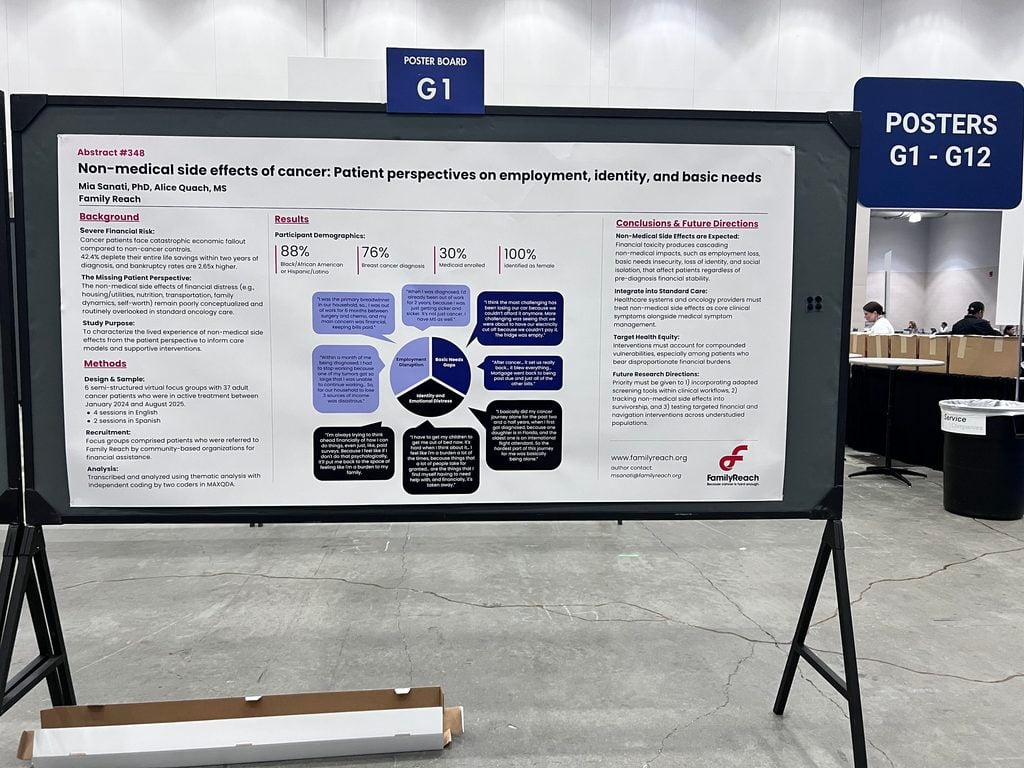
These side effects are connected, and they often happen at the same time. They showed up both for people who said they were doing fine with money before cancer and those who said they were having a hard time before their diagnosis.
Family Reach works to step in early and catch what we can. But families don’t always reach us before the problems start. That is why we believe that conversations about money and meeting basic needs should be part of standard cancer care, checked early and often, just like physical side effects.
Treating the Whole Person
The good news is that financial interventions really work. When families get support finding resources and paying for basics, their financial stress can go down, and their day-to-day living conditions can improve (Edward et al., 2023).
At Family Reach, this is our mission. Through our Financial Resource Center, we help families facing cancer access essentials like housing, food, utilities, and transportation. We connect them with resources they can rely on throughout their treatment so they can focus on healing. Our research helps us learn what works best.
Cancer costs more than treatment. Together, we can make sure no family has to choose between paying rent and getting care.
Because cancer is hard enough.
Need support? Visit our Financial Resource Center. Want to help? Make a gift or sign up for our newsletter to follow our work.